Wednesday, October 15, 2014

Sintra and Lisbon

Just a warning--I took 580 photographs during our vacation. (I'm happy not to be spending dollars on film and processing these days.) My goal is to give you a taste of what we saw without overwhelming you with pictures. However, this is a challenge, and so this posting may be a little long. Sorry about that!

We returned to Lisbon from Lagos via train and spent a couple of days there before heading to Italy for the second half of our vacation. On the first of these two days, we took a train about 45 minutes north from Lisbon to the charming city of Sintra, which is famous for its three castles, each of which we toured. These are the Pena Palace, built in 1836; a Moorish castle, dating to the 9th century; and Regaleira Palace, dating back to 1697.

Two of the castles, Pena Palace and the Moorish castle ruins, sit high on a mountain against which the city of Sintra is nestled. We took a bus to the top; a walk up would have been exhausting, since the road is exceedingly steep and full of switchbacks. Even with that, the walks between the two castles and on the respective castle grounds were tiring.

Pena Palace is at the very top of the hill. A chapel had once been at this site but had fallen into ruin. Prince Ferdinand acquired the entire area, including the land occupied by the Moorish castle, and built the palace as a summer residence for Portugal's royals. A public park now makes up the entire area. To give you a sense of the entire structure, I borrowed this photograph from another website.


These are some of my photographs.


The interior of the castle is, of course, amazing and extravagant. Here are examples--a dining room and a bedroom.


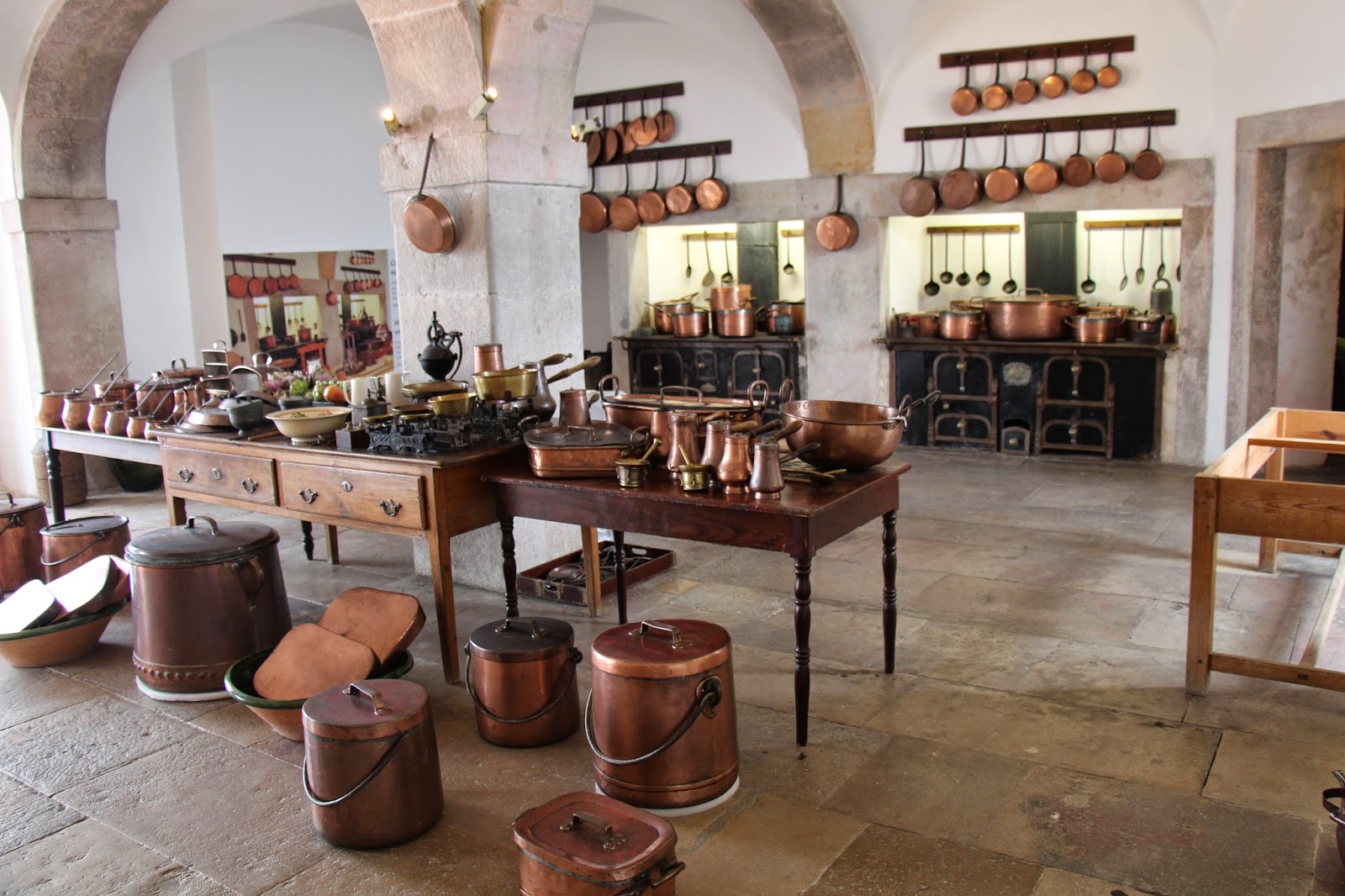
The kitchen was enormous and was filled with dozens of copper pots and pans.

We walked next (down) to the Moorish castle ruins. Along the way, we spotted a number of other impressive homes and buildings built on the hill but outside the park.


An interesting aspect of the Moorish castle was the way in which it was embedded or fit into the rocks and boulders on the hill.


There were not rooms to see, but there were plenty of interesting walls and spaces that had been stables, common kitchens, or similar facilities.


Here is an example of what I mean by embedding the castle into the surrounding rock features.


I took the next three photographs from a parapet along one Moorish castle wall. The first looks back up at the Pena Palace, the second looks laterally along the hillside at parts of the castle ruins, and the final picture looks down into Sintra at the Regaleira Palace.


Later, when we were about to tour the Regaleira Palace, I took this picture looking back up at the Moorish castle.


Regaleira Palace is, like so many of the old buildings in Europe, filled with art, impressive ceilings and floors, and striking furnishings.


I took this picture looking back at Regaleira Palace as we were about to board the train to return to Lisbon.


On our second day in Lisbon, we visited two museums: the National Tile Museum (Museu Nacional do Azulejo) and the Gulbenkian Museum (Museu Calouste Gulbenkian). The first of these is in an old convent.


On display are thousands of ceramic tiles from five centuries. Many were hand painted, and frequently, collections were designed to create more complex and intricate patterns once put into place.


Some of the rooms in the museum had little to do with the tiles. For example, here is one of the convent chapels. The ceiling was filled with paintings and other kinds of artwork.


Floors in parts of the chapel fascinated me, given the many kinds of wood used and the beautiful ways in which they were themselves "tiled."


At the end of the tour and to demonstrate the ways in which ceramics are broadly used for artistic expression, there was a room displaying pieces that were definitely not tiles. These are not rusty cans but ceramics.


There were several pieces involving sea life themes.


On the grounds of the second museum, the Gulbenkian, there are actually two art museums--the Gulbenkain and the Modern Art Centre. We toured the Modern Art Center first. Several of the modern art pieces were quite clever, involving mechanisms, optical illusions, video art, and the like. They were difficult to photograph. As we moved into the Gulbenkian, we encountered a special area called "The Meeting Point." Here was a display meant to show an initiative between the Gulbenkian and the Modern Art Centre to create a dialogue between the two collections. On display there were a Rembrandt and a piece by Paula Rego, each chosen because of the common theme of the representation of time.


The Gulbenkian has stages devoted to Egyptian, Greek, Middle Eastern, Roman, and other collections. Near the end, we came to a special display of French art, including works by Rene Lalique, some of which you see here.


Tuesday, October 14, 2014

Lagos, Portugal

As you may know, we spent the last three weeks of September and first week of October in Europe, first in Portugal and then in Italy. So, my plan is to share some of our adventures with you in the next several blog postings.

After three plane hops, we arrived in Lisbon and spent one night there in a hotel before boarding a train to Lagos, Portugal. Our guide book says that the correct pronunciation is "Lahgoosh." Lagos is on the southern coast of Portugal in a region of the country called the Algarve. Nearly all of the coastline comprises a set of resort communities and cities along the Atlantic Ocean.

Months ago, we learned that our Australian friends, Margaret and Murray were going to be in Portugal during this time, and so we decided to add to our original plans for an Italy-only trip by adding the Portugal segment at the beginning. We had not seen them since 2012, when they were in the U.S. and we hosted part of their tour of our country. Naturally, it was great to see them again and to engage in the constant light-hearted fun that is so much a part of our being together. After arriving on the train, we rendezvoused at the guest house where we had arranged for rooms. Our host snapped this reunion picture for me.


This picture will give you a little bit of an idea of the nature of the coastline near Lagos. To the east from the city there is a miles-long, open stretch of perfect beach. To the west, there are numerous, somewhat isolated beaches nestled in spots where the cliffs have eroded enough for a beach to appear. The cliffs extend for miles to the west, and the sea has carved them into the most amazing grottos. More on that below.


Lagos has little to support its economy beyond tourism. However, fishing is a significant business primarily devoted to supporting local consumption, both for Lagos residents and the many restaurants in the city. On one of our early strolls through town, we discovered the local seafood market, which was a colorful and fascinating place to explore.


If you purchase seafood, the vendors will prepare it for you as desired (cleaning, filleting, or cutting into steaks).


The upper floor of the market offers fruits, vegetables, and spices. Kathie won't find this photograph very flattering, I suppose, but the colors are so nice, and I loved how excited she was about the fresh figs she had just purchased for our afternoon snacking. (Nearly every afternoon while there, Margaret, Murray, Kathie and I gathered on an outdoor deck at our guest house to enjoy fruits, crackers, cheeses, and wine while we visited and shared stories. Lots of wine! There are lots of good wines in Portugal!)


OK, back to the grottos. There are numerous boat tours available from the Lagos marina. Some take you out for food and sailing, others go dolphin watching, and many tour the grottos. We did the latter, so here are a number of photographs meant to illustrate the nature of the eroded cliffs, secluded beaches, and constant water sports.


Our guide actually motored us through a number of arches and also ventured into a couple of caves.  With the sea swelling as it does, I wouldn't have wanted to attempt such a thing--too easy to bash into the sides of the arches and caves. The guide became particularly agitated at one snorkeler who insisted on being in a cave too. I guess he disliked having to maneuver around such a person and thought it unsafe for someone to be so near motorized boats and their propellers. These tour businesses obviously feel that they have priority in these grottos, but I can see the attraction for snorkelers.


This was not our vessel. I just thought it was a pretty image. I believe this was one of the barbecue and dolphin watching tour boats.


We spent one day on the beach and probably should have spent more. The water was cold, but I did get in one good swim.


Lagos is a walled city, as many old cities in Europe seem to be.


There are always fascinating old buildings to see, many of them churches, of course.


This one was the old slave market!


I mentioned light-hearted fun. Food and wine were often a part of such times, but there was lots of ice cream available, usually in outrageous configurations, evidence of which you can see below.


I know the following picture was taken on September 16th, because it was our 24th wedding anniversary. On that day, we rented a car and drove west to some smaller communities along the coast. This one was taken in Salema on a day when the Atlantic was quite rough. The waves were amazing to watch. We walked the beach looking for two instances of dinosaur footprints that were supposed to be captured in rocks, but we never found them.


We did stop at a ceramics shop. I liked this display on one of the outer walls.


Further on, we visited Cape Sagres. An old fort sits atop a rugged point there. Prior to the discovery of the new world by explorers, including many Portuguese, people at the time thought of this promontory as the end of the earth, since it reached furthest west into the Atlantic from the continent.


Again, the sea was very active on the day of our visit and so beautiful to see crashing against cliffs and rolling up onto the beaches.


On our looping walk along the cliff near the fort, we came across several fishermen. Imagine this gentleman fishing from the top of the cliff in the photo just above. He used a very, very long pole, and I watched him cast his line in a long arching shot out into the sea before it settled more or less straight down. I never saw him bring up any catch, and wondered how one could reel a fish up so far without it getting free or being damaged banging against the rocks. I still wonder why fishing in this way would have an advantage over fishing from a beach or a boat (unless, of course, you don't have a boat). Maybe there is something about fish species that are drawn to the waters quite near cliffs like these.


So, that is a rough intro to Lagos and the Algarve. Next posting will be about Lisbon and Sintra.