Thursday, October 18, 2007

Maryann and Barbara

Why do we allow so much time to pass and not stay in better touch with those who are dear to us? When Paula and I were young, we periodically got to spend time with two very special cousins--Maryann and Barbara. (I can't say "Maryann" and not have "and Barbara" roll right off my tongue!) Unfortunately, as we entered our adolescent and adult years, we became so involved in our own lives that we failed to maintain these ties. Our respective parents were connected, and through them, we would hear occasional news about our cousins, but with the loss of our parents, even these opportunities diminished. The good news is, though, that retirement and personal interests have compelled me to work at correcting these kinds of situations. So, after some recent exchanges of emails, I had the distinct privilege this last Monday evening of meeting Maryann and Barbara for dinner.


Not one of the three of us could recall with any certainty the last time we had seen each other, but it may very well have been 20 years or more. Here are the three of us (Barbara, me, Maryann) circa 1947-1948. Don't you just love their bonnets and my matching coat and cap?


And here are the three of us at dinner on Monday.


We just about closed the restaurant, even though we met there at 6PM for dinner. We talked and talked, caught up on our respective lives, and shared pictures with each other of our children, grandchildren, spouses, and others. We agreed that we need to continue to stay in touch and to get together periodically. We were all sorry that others, including their sister Kathy and my sister Paula, couldn't have joined us. But this is something we can and will correct as we go forward. As I said at the outset, Maryann and Barbara and Paula and I enjoyed being together when we were young. (Paula: One of the first things Maryann recalled at dinner was the famous story about how she and I conspired to try to frighten you and Barbara one evening at their house. You will know the details, of course!! So many of us remember this story, that I guess it must really be true!!) Anyway, in closing, here are all four of us many years ago.

Tuesday, October 16, 2007

St. Petersburg

I definitely took the greatest number of trip pictures during our visit in St. Petersburg, mostly because of the opulence of the summer palace of Peter the Great that we toured at Peterhof. On our way to the summer palace, we saw this interesting church alongside the road, so I snapped a picture. I'm sorry I don't recall what denomination it was, but I loved the ornate architecture.


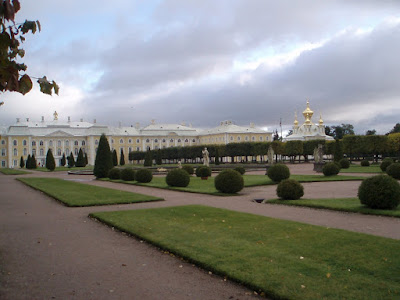
The summer palace sits within a vast park, which is filled with trees, groomed walks, flowers, fountains, and statuary. The palace itself is filled with treasures and has many many features covered with gold leaf. Anticipating German occupation, steps were taken to remove many of the treasures, at least to take samples, including samples of wall coverings, furniture, china, and other items. The palace was painstakingly restored follwing the war. At the risk of showing you too many pictures of it, here is an initial view of the palace as we approached it for our tour.

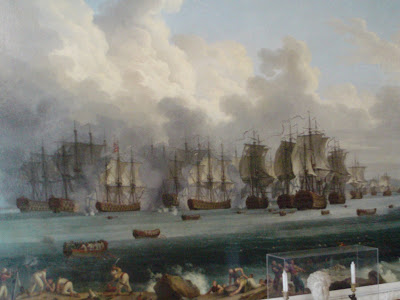
There are many paintings in the palace. Here is one from a series related to some famous naval battle. There are also many of members of the royal family.

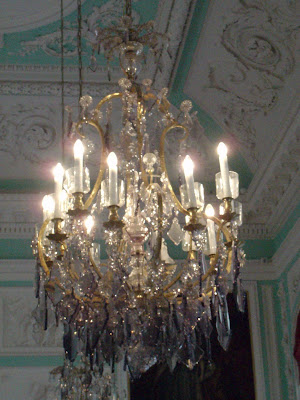
We saw several immense chandeliers.

Here you can get an idea of how much gold leaf adorned walls and features throughout the palace.


This dining area included very fancy china, silver, and crystal settings.


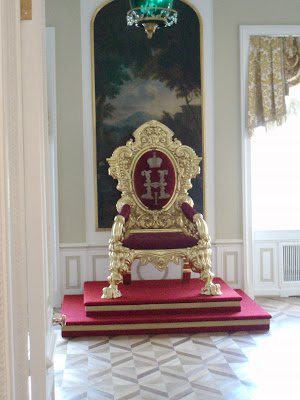
This was a throne that Tsar Nicholas used. That "H" is an "N" in the cyrillic alphabet.

Nearly every room had an ornate porcelain or tile stove like this one.


Here is a view from the "front" of the palace looking toward the sea and some of the fountains.
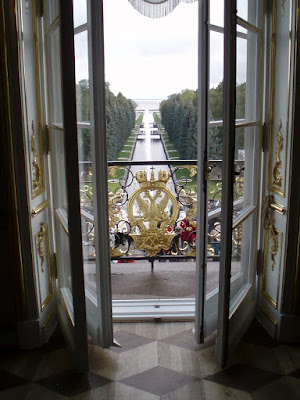

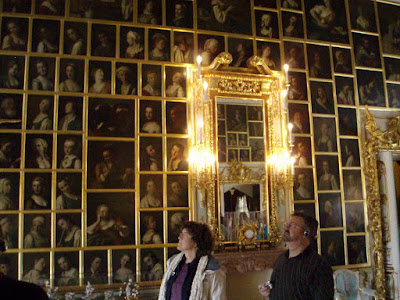
There were some rooms, an "oriental room" for example, where pictures were not allowed. The room below was described as a portrait room. However, the portraits were simply for the purpose of decoration and were not family members or other well-known individuals. In fact, we were told that all of the portraits were posed by about 12 individuals total, and so you could see similarities in the faces, though the poses varied significantly. The artist had "hidden" several of himself throughout.

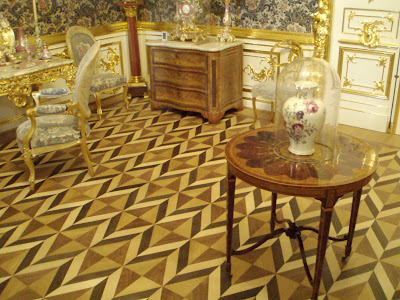
Most of the floors and much of the furniture involved various kinds of woods and many intricate inlays.

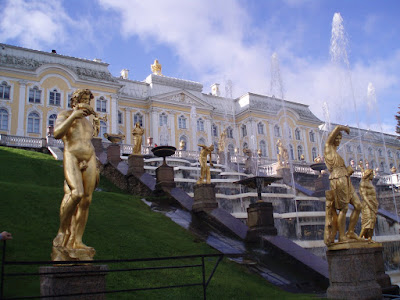
The following three shots provide a sample of the fountains in the garden. The first and third are the major fountains that extend from the front of the palace toward the Baltic Sea.
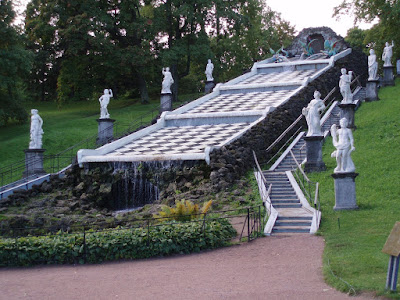
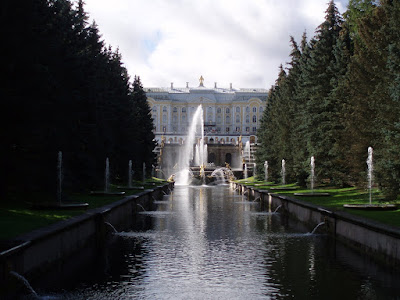

Following the tour of this palace, we were transported by hydrofoil across the sea to St. Petersburg. This took approximately a half hour. Peterhof and the palace sit at quite some distance from St. Petersburg itself. Once we arrived there, we were treated to a beef stroganoff lunch at one of the grand hotels in the city. A small group of musicians played authentic Russian music for us during the luncheon.


After lunch we took a bus tour of the city, with a few stops at selected sites. The building below was the winter palace for the Tsars. Now it is occupied by the Hermitage Museum.
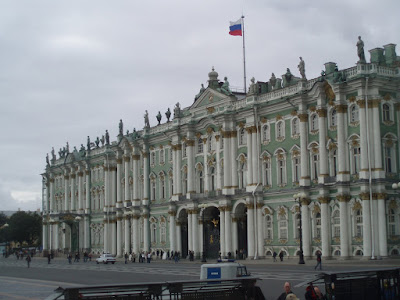

We must have seen at least a half dozen wedding parties during the afternoon. Most were at famous or important locations for picture taking. I thought the brides' dresses were quite different from the more delicate styles we typically see.


Below is the cruiser Aurora, which fired a first shot to signal the beginning of the October revolution of 1917 (that is to signal that the winter palace should be stormed).
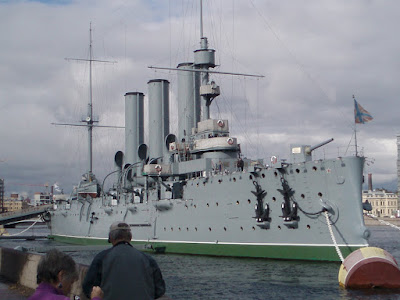

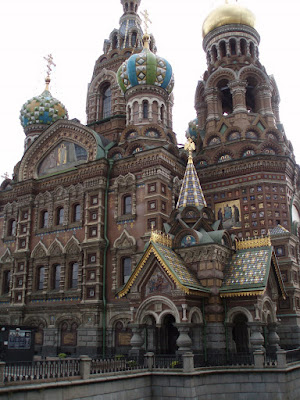
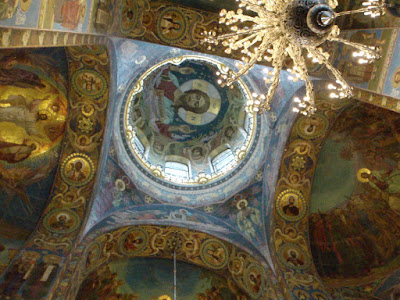
Finally, we toured the Church of the Resurrection (Church on the Spilled Blood) which was constructed atop the spot where Alexander II was assassinated in 1881. In addition to its fascinating exterior, the interior is completely (and I mean every square inch) covered with tile mosaics documenting the life of Christ from birth to ascension.



St. Petersburg is filled with history and elegance. There is so much to see there. If you are interested in learning more about some of the places mentioned above and other sites in St. Petersburg, you can find an interesting virtual tour of the city here.

Thursday, October 11, 2007

Finland

The day after our stop in Germany and tour of Berlin was spent at sea as we traveled toward Helsinki, Finland. The following morning we found ourselves docked there. We had selected a tour for the day that included a chance to see rural areas as well as Helsinki itself. Our first stop was in a charming medieval community called Porvoo, which offered picturesque shops along cobblestone streets. In addition to a photo of Porvoo, here is a shot of my beautiful wife on the walking bridge leading into Porvooo.


Next, we traveled to Savijärvi Farm. This farm originally specialized in dairy cows, but some years ago the Finnish government determined that there were too many dairy farms and encouraged diversification. So, the owner of Savijärvi Farm at that time (a couple family generations ago) sold his cows to someone in Russia in exchange for horses. Breeds of horses from Russia are evidently excellent, including Arabian and other lines. The farm trains horses and riders, offers breeding services, and raises its own horses. The farm is a total family operation. There were several houses on the property which were occupied by grandparents and their various children and families. Part of the family manages the horse breeding operations, others manage events and training, and others manage tourist services. Below is the original family home. After an introduction to the horses, we were treated to a wonderful meal in this home.


Below are a couple photos of horses shown to us. Although I failed to take a picture of them, they also showed us two Shetland ponies. The story was that the grandfather had always been opposed to having ponies, that is until his grandchildren arrived on the scene. He therefore surprised everyone one Christmas by arranging for the two ponies to be brought into the living room as a gift to the grandchildren. They have been at the farm ever since. All of the animals we saw were beautiful. I know Kathie would have loved to go for a ride.


I mentioned a meal in the main house. Below is a shot of the desert included with that meal. Those are locally grown berries, including currants and cranberries, which were dressed with a light, sweet sauce. The other courses had consisted of nettle soup and a stew made with fish. That's right, nettle soup, which we learned is not uncommon in the Baltic region. If you have, like me, experienced pulling nettles as weeds and getting your hands stung, you can't quite imagine eating the things. But the plant is evidently even healthier for you than spinach, and when properly prepared, it has a wonderful taste. Kathie and I both liked the soup.


After the tour of the rural areas, we were treated to a tour of Finland's capital city, Helsinki. One of the most unusual sites there was the Rock Church. As I understood it, the original plan had been to build a more traditional church at the site, but residents in the neighborhood objected to their views being obstructed. So, the architect decided to blast a recess into the rock and set the church down into it with a dome erected overtop as the church's roof. Although we didn't get to hear anything except recorded music inside, the church is supposed to have outstanding acoustics. Below is one picture from outside and another in the sanctuary.


Finally, here is a picture of the Lutheran Cathedral that dominates one side of Senate Square in Helsinki. This square is bordered on its other sides by government buildings and shops.

Monday, October 08, 2007

Kiel Canal and Berlin

After leaving Amsterdam at 5PM, we cruised in a northerly direction into the North Sea and then east along the coasts of The Netherlands and northwest Germany to the Elbe River. Of course, we were sleeping during most of this time, though the North Sea was fairly rough and the boat rocked us as we slept or tried to sleep. The next morning, we were anchored in an area where the river enters the North Sea near a German town called Brunsbüttel, which is at one end of the Kiel Canal. The canal cuts across Germany to the Baltic Sea and allows a ship to avoid having to travel all the way around Denmark (essentially a large peninsula that stands between the North Sea and the Baltic Sea). You can read more about the canal and even see webcams of activity on the canal by clicking here.

I previously posted a picture of a tug boat pulling the stern of the Prinsendam around so that we could directly enter the canal. Here is another shot of our ship in the lock that controls entry to the canal and one looking back at the lock as we began our trip through the canal.


The day passing through the canal was delightful. It was sunny and comfortable to be out on the deck in a lounge chair, and since it was a Sunday, many people were out along the canal (which seemed to have bike or walking paths on both sides) enjoying the day. They loved seeing the cruise ship pass by and waved and waved at us all along the way. We could see the German countryside, as well as small communities and some larger ones. It was quite late and dark when we finally exited the canal at its entrance to the Baltic Sea. During the night we passed along the northern shore of Germany, arriving the next morning at Warnemünde, Germany. While the ship was docked there during the day, we traveled by train to Berlin for a tour. The train trip was three hours each way, and we spent about seven hours in Berlin, so it was a long day but a very interesting one. Unfortunately, it was quite rainy during the morning. We toured by motor coach, and though we did get out occasionally, it was usually too wet too spend much time outside. I took lots of pictures through the windows of the bus, so some of what you will see below may be a little blurry.

Our impressions of Berlin were very mixed. We liked the city, but we were deeply struck by its sometimes severe feel. Obviously, it is a city and a citizenry that has suffered a great deal over the past 60 years. The buildup and oppression of the Nazis was soon followed by the near total (85%) destruction of the city by the Allies' bombing campaign. Then the city was ripped apart by its separation into east and west Berlin. The two sides of the city were markedly different and had different feels. Much of the city has been restored through replication of original structures, so you see "old" buildings that are actually relatively new. Here are just a few of the sites we took in.

You may recall the historic 1933 photograph or movie of Nazi-motivated burning of books by students and Nazi brown-shirts at a plaza called Bebelplatz. The "window" below is in the surface of the plaza where this burning took place and allows one to look down into an empty library that represents a memorial to this censorship event.


A visit to Berlin would not be complete without a stop at "Checkpoint Charlie", the most famous of several points where passage between east and west Berlin could occur. It was here that a famous confrontation between the US and USSR took place in October of 1961 with tanks facing off against each other. Today, the US guard station still stands, and photographs of a US soldier looks east, while on the other side a USSR soldier looks west.


Most of the Berlin wall is now gone, but its presence is recorded and memorialized throughout the city by a brick line that follows its original path across streets, walks, and plazas. Elsewhere, short sections of the wall have been kept as a reminder of that period of Berlin's history.


In 2005, a Holocaust Memorial was opened to the public. You can read much more about it here and also here. I took the following photograph through the bus window. It is ironic that the bunker Hitler used in his last days is merely 100 yards away from this site.


Other famous buildings and sites we visited included the Reichstag (still a principal government building), the Berlin Cathedral, and the Brandenburg Gate. (You can click on each of these to learn more.) We only drove past the Reichstag, but we toured the Cathedral and stopped to walk near the Brandenburg Gate. Photos of each are below--sorry about them being so dark, but as I said above, it was quite a rainy day.


Tuesday, October 02, 2007

Towel Critters

And now, back to the cruise...

Here is a picture of our cabin steward. You can see why he brought a smile to my face each day. (I recently sent a card to grandson Henry with a copy of this picture just for him.) His name was Made, and he was a most dedicated and considerate worker.


The cabin stewards had a great sense of timing. When we went to breakfast, they cleaned the cabins and made the beds. When we were at dinner, they turned down the beds, left a chocolate on our pillows, and provided us with a packet of information, including a small newspaper and an itinerary of events, both onboard and ashore, for the next day's stop. To a person, cooks, dining attendants, recreational staff, cabin stewards, and literally all other staff members were fun, polite, and eager to provide service. This is a real hallmark of the Holland-America Line, we think.

When we returned to our cabin for the night, usually following a musical or comedy show in the ship's theater, we found the turned-down bed and chocolates and the latest day's edition of a "towel critter." As the days went by, there was more and more conversation about these amusing little guys. Rather than return them each day, we kept several (only for the duration of the cruise), creating a little menagerie at one end of our couch. I may have missed one or two at the start of the trip, but I got pictures of most of them as you will see below. The majority of them are easy to identify. A few are not obvious to us. I'll leave it as an exercise to the reader to assign names to each one.